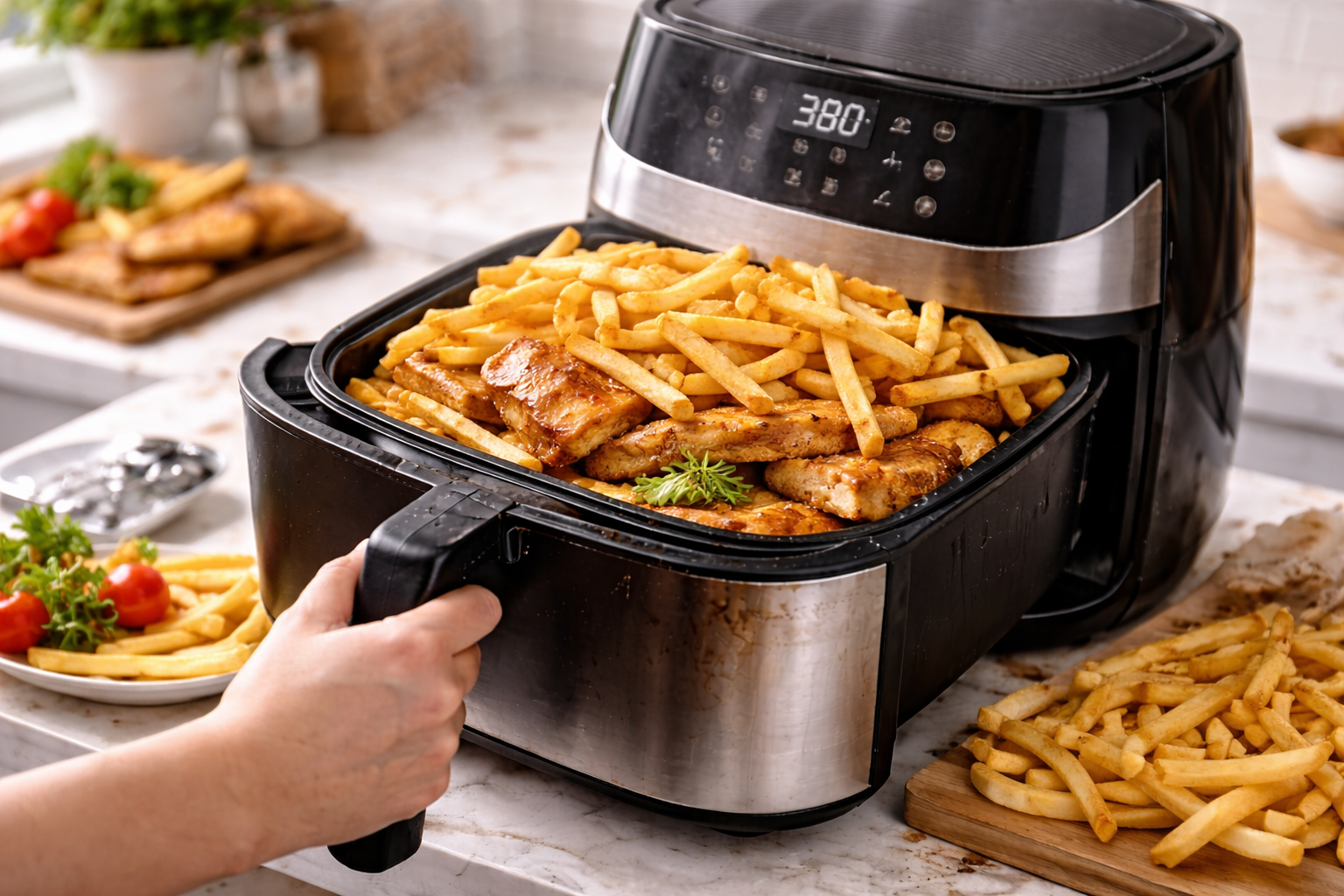
Overcrowding an air fryer basket feels like a harmless shortcut. You are hungry, the food is ready, and the basket looks like it could probably take just a bit more. What is the worst that could happen? Quite a lot, as it turns out. And most of it explains why so many people quietly decide their air fryer is overrated.
An air fryer is not forgiving of excess. It is a machine built on airflow, precision, and a certain amount of restraint. When you ignore that and treat the basket like a holding pen for everything you want cooked at once, the appliance does not protest. It simply underperforms.
Table of Contents
- You stop frying and start steaming
- Crispness disappears, even if the food is cooked through
- Higher heat leads to uneven results, not better ones
- Moisture has nowhere to escape
- Cooking times become unreliable
- You lose surface area, which matters more than volume
- Breaded and battered foods suffer the most
- Shaking becomes ineffective
- The air fryer works harder and less efficiently
- Cleanup becomes more annoying
- Why this mistake is so common
You stop frying and start steaming
The first and most important thing that happens when you overcrowd an air fryer basket is that you change the cooking method entirely. Air fryers rely on hot air moving rapidly around food. That circulation is what creates browning, crisp edges, and that familiar fried-like texture.
When food is packed tightly together, the air has nowhere to go. Moisture released from the food builds up, heat becomes uneven, and instead of dry, aggressive convection, you get steam. Steam is gentle. Steam is polite. Steam is also the enemy of crispness.
This is why overcrowded fries come out limp, pale, and oddly damp. They are not undercooked in the traditional sense. They are cooked in the wrong environment.
Crispness disappears, even if the food is cooked through
One of the most confusing outcomes of overcrowding is that food can be fully cooked yet deeply unsatisfying. Chicken may reach a safe internal temperature but lack any real browning. Vegetables soften but never caramelize. Breaded foods go from crunchy to sponge-like.
This happens because browning requires direct exposure to heat and dry air. When pieces are touching or stacked, large parts of the surface never meet either. Instead, they absorb moisture from neighboring ingredients and sit in a humid pocket until the timer runs out.
Turning up the temperature does not fix this. It often makes things worse.
Higher heat leads to uneven results, not better ones
Many people respond to overcrowding by increasing the temperature or extending the cooking time. This feels logical. More heat should solve the problem. In reality, it creates a new one.
Exposed areas, usually the top layer, begin to overcook while crowded sections underneath lag behind. You end up with burnt edges and soft centers, or dry outer surfaces with underdone interiors. The air fryer is doing its best, but it cannot deliver even results when airflow is blocked.
This is why overcrowded food often looks inconsistent. Some pieces brown aggressively while others seem untouched by heat.
Moisture has nowhere to escape
All food releases moisture as it cooks. Potatoes, chicken, vegetables, frozen foods, all of them. In a properly loaded air fryer basket, that moisture is carried away by the circulating air. In an overcrowded basket, it lingers.
That trapped moisture condenses on surfaces, softens coatings, and prevents browning. It can also drip down into the bottom of the basket, where it mixes with oil and residue, creating smoke and unpleasant smells later on.
Over time, this buildup can affect flavor and even cause the air fryer to smoke during future cooking sessions.
Cooking times become unreliable
Overcrowding makes timing unpredictable. Recipes that normally work suddenly fail. Food that usually takes fifteen minutes now needs twenty five. Even then, results are inconsistent.
This happens because air fryers are calibrated for a certain amount of open space. When that space disappears, heat distribution changes. The appliance may cycle differently, recover heat more slowly, or struggle to maintain temperature when the basket is opened.
This unpredictability is frustrating, especially for people who rely on air fryers for quick, repeatable meals.
You lose surface area, which matters more than volume
Capacity is often misunderstood. A basket might technically hold several pounds of food, but that does not mean it can cook that much well. Air frying is less about how much fits and more about how much surface area is exposed.
Flat, spread-out food cooks better than a tall pile. Ten fries laid out in a single layer will outperform twenty stacked together. Surface exposure allows heat to do its job.
When you overcrowd, you sacrifice surface area for volume. The result is slower cooking and inferior texture.
Breaded and battered foods suffer the most
Overcrowding is particularly cruel to breaded foods. Coatings rely on heat and airflow to set properly. When pieces touch, coatings rub off, absorb moisture, and lose structure.
This is why breaded chicken can emerge patchy or bald in spots. The coating never had a chance to firm up before moisture softened it. In extreme cases, it slides off entirely and collects at the bottom of the basket.
Battered foods fare even worse. Without enough airflow, batter drips, pools, and burns, leaving behind a mess rather than a meal.
Shaking becomes ineffective
Many air fryer instructions recommend shaking or flipping food halfway through cooking. This advice assumes there is room to move things around.
In an overcrowded basket, shaking does little. Food is wedged together. Pieces do not rotate freely. You may rearrange the top layer slightly, but the underlying problem remains.
Instead of redistributing heat exposure, shaking simply compresses everything further.
The air fryer works harder and less efficiently
Overcrowding does not just affect food. It affects the machine.
Blocked airflow forces the fan and heating element to work harder to maintain temperature. Heat recovery slows. Cooking cycles become longer. Energy efficiency drops.
While modern air fryers are built to handle variation, repeated overcrowding can contribute to wear over time, especially if grease and moisture buildup increase as a result.
Cleanup becomes more annoying
Overcrowded cooking leads to messier baskets. Moisture, oil, and loose crumbs collect more readily when food steams rather than crisps. This residue sticks, burns, and becomes harder to clean.
People often blame poor nonstick coatings for this, when the real culprit is cooking too much food at once. A basket used within its limits is easier to maintain.
Why this mistake is so common
Overcrowding happens because air fryers look deceptively spacious. A deep basket suggests capacity. Marketing reinforces this by emphasizing volume rather than usable space.
There is also a psychological factor. Cooking in batches feels inefficient. The promise of the air fryer is speed. Slowing down feels like defeat.
But batch cooking does not always mean double the time. Smaller loads often cook faster and more evenly. Two quick batches can outperform one crowded, disappointing one.
How to avoid overcrowding without losing your mind
The simplest rule is this: food should sit mostly in a single layer, with a little space between pieces. Some overlap is fine. Compression is not.
If you are cooking for multiple people, plan for batches and keep finished food warm in a low oven. Use racks or multi-level accessories only if they allow proper airflow.
When in doubt, cook less than you think you need. You can always add more. Fixing soggy food is much harder.
The payoff of restraint
When you stop overcrowding the basket, air fryers start behaving the way they are supposed to. Fries brown evenly. Chicken skin crisps. Vegetables roast rather than wilt. Cooking times become predictable again.
The machine feels more reliable. The food feels intentional.
Overcrowding is not a dramatic mistake. It is a quiet one. It does not cause alarms or obvious failure. It simply robs the air fryer of its strengths.
Give the food space. Let the air move. The difference is immediate, and once you notice it, you will never willingly pack that basket to the brim again.
Leave a Reply