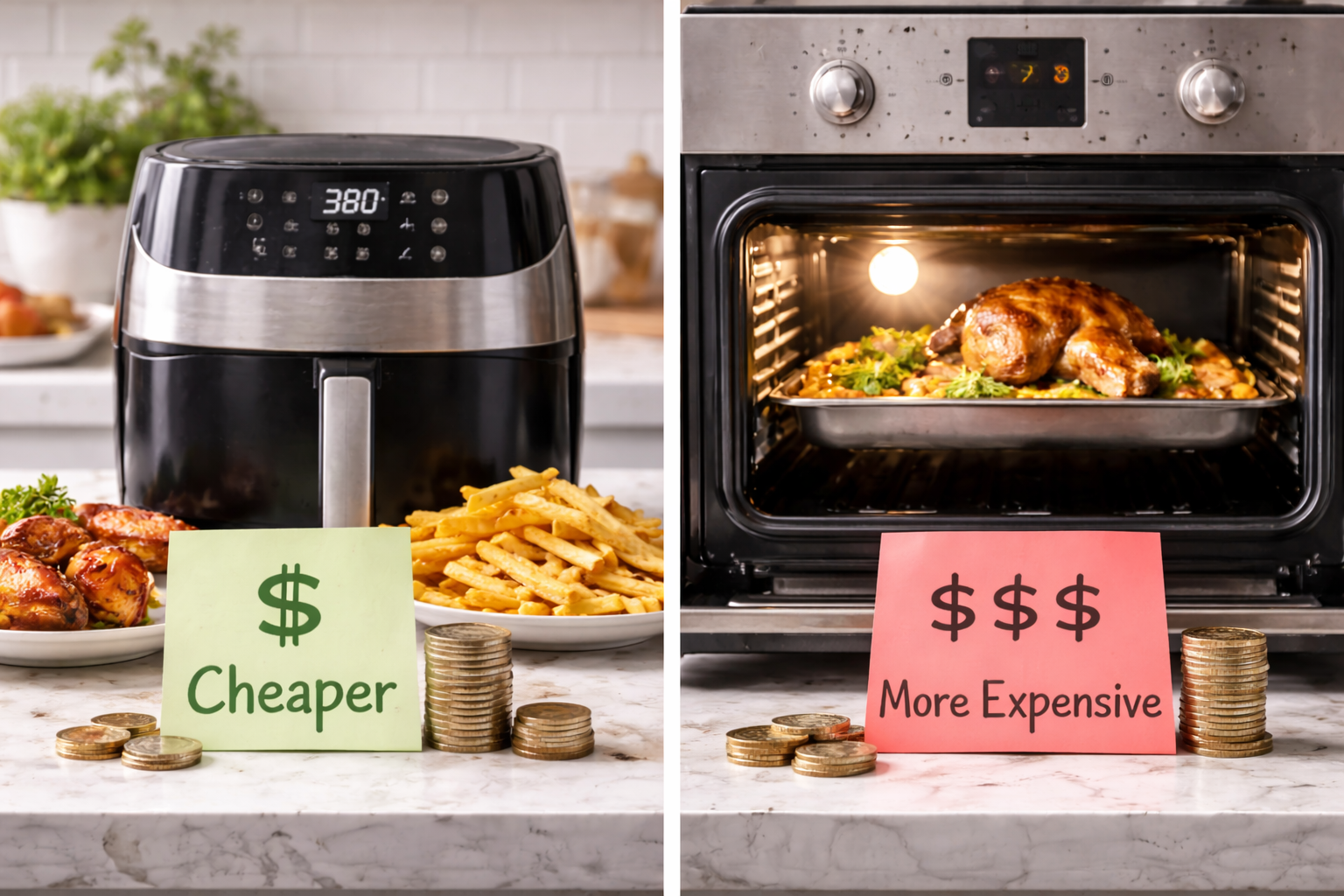
The short answer is yes, air fryers are usually cheaper to run than ovens. The longer answer is more interesting, because it explains why that savings exists, when it actually matters, and when the difference is so small you will not notice it on your bill at all.
Air fryers did not become popular because people were chasing energy efficiency. They became popular because they are fast. Speed, it turns out, is exactly why they tend to cost less to run.
Table of Contents
- Power versus time is the real calculation
- Smaller space, less energy waste
- Real-world running cost differences
- Preheating is the silent cost
- Batch size matters more than the appliance
- Gas ovens change the equation slightly
- Heat loss and kitchen comfort
- Efficiency versus necessity
- So are air fryers cheaper to run than ovens?
Power versus time is the real calculation
At first glance, air fryers can look inefficient. Many models draw between 1,400 and 2,000 watts, which is not far off a full-sized electric oven. That number alone makes some people assume the running costs must be similar.
They are not, because wattage only tells you how much power an appliance uses at any given moment. It does not tell you how long it uses it for.
An oven typically takes ten to fifteen minutes just to preheat. Then it runs for however long your food needs, often thirty minutes or more. During that time, it cycles on and off to maintain temperature, pulling a significant amount of power throughout.
A high quality air fryer heats up in a few minutes, sometimes less, and usually finishes cooking in half the time. The result is fewer total minutes drawing power, even if the power draw itself is fairly high.
Electricity bills care about total energy used, not momentary effort.
Smaller space, less energy waste
Ovens are designed to heat a large cavity. That is their job. Even when you are cooking a single tray of food, the entire oven has to come up to temperature and stay there.
Air fryers heat a much smaller space. The basket or chamber is compact, enclosed, and designed for rapid air circulation. Less air to heat means less energy required to get it hot and keep it hot.
This efficiency is especially noticeable for small meals. Reheating leftovers, cooking a portion of fries, or roasting a couple of chicken thighs barely justifies turning on a full oven. An air fryer handles these tasks with far less wasted heat.
Real-world running cost differences
In practical terms, running an air fryer typically costs a few cents per use. A full-sized electric oven often costs two to three times that for a comparable cooking task, sometimes more depending on duration and local electricity rates.
The exact numbers vary by country, tariff, and appliance model, but the pattern stays consistent. Short, high-intensity cooking favors the air fryer. Long, slow cooking favors neither appliance, though the oven often becomes unavoidable.
Over a week of regular use, the savings can be noticeable. Over a year, especially in households that cook frequently, they can add up to a meaningful amount.
Preheating is the silent cost
Preheating is where ovens quietly rack up expenses. Many people forget to account for it because it feels like part of the process rather than a separate energy draw.
An oven that preheats for fifteen minutes before cooking anything has already used a chunk of electricity before food even enters the picture. An air fryer either preheats in a couple of minutes or does not require preheating at all for many foods.
That difference alone explains a large portion of the cost gap.
Batch size matters more than the appliance
This is where things get nuanced. Air fryers are cheaper to run per session, but they are not always cheaper per meal.
If you are cooking for a family and need multiple batches in the air fryer, the energy savings shrink. Running an air fryer three times in a row to cook dinner can approach or even exceed the cost of using the oven once.
Ovens make more sense for large trays of food, roasts, or batch baking. Air fryers shine for smaller portions and quicker meals.
The most cost-effective kitchen is one that uses both appliances strategically rather than trying to force one to do everything.
Gas ovens change the equation slightly
Gas ovens complicate the comparison. Gas is often cheaper per unit of energy than electricity, depending on region and pricing. That can make gas ovens competitive, especially for longer cooking times.
However, gas ovens still suffer from the same inefficiency issues. Large cavities, long preheats, and extended cooking durations all add up. Air fryers running on electricity can still come out cheaper for short, everyday cooking tasks, even against gas.
The difference is smaller, but it does not disappear.
Heat loss and kitchen comfort
There is also a secondary cost people forget. Ovens heat kitchens. In summer, that extra heat often leads to fans or air conditioning running longer. In winter, it may be welcome.
Air fryers release far less ambient heat. This does not show up directly on your energy bill as a line item, but it affects overall household energy use, especially in warmer months.
Comfort has a cost, even if it is indirect.
Efficiency versus necessity
Air fryers are not magic money-saving machines. They are efficient within a specific range of tasks. Expecting them to replace ovens entirely is unrealistic and unnecessary.
If you bake bread, roast large joints of meat, or cook for a crowd, the oven remains essential. If you cook small meals regularly, reheat leftovers, or want fast results with minimal waste, the air fryer earns its keep.
The savings come from choosing the right tool at the right time.
So are air fryers cheaper to run than ovens?
In most everyday situations, yes. They use less total energy for small to medium cooking tasks, heat up faster, and waste less heat. Over time, that translates into lower running costs.
They are not cheaper in every scenario, and they are not a replacement for all oven cooking. But for the way many people actually cook, quick dinners, reheated meals, small batches, they are one of the more energy-efficient appliances on the counter.
The real win is not just the money saved. It is the feeling that you can cook without committing to a full preheat, a long wait, and a hot kitchen. Cheaper to run is part of the appeal. Easier to live with is the rest.
Leave a Reply