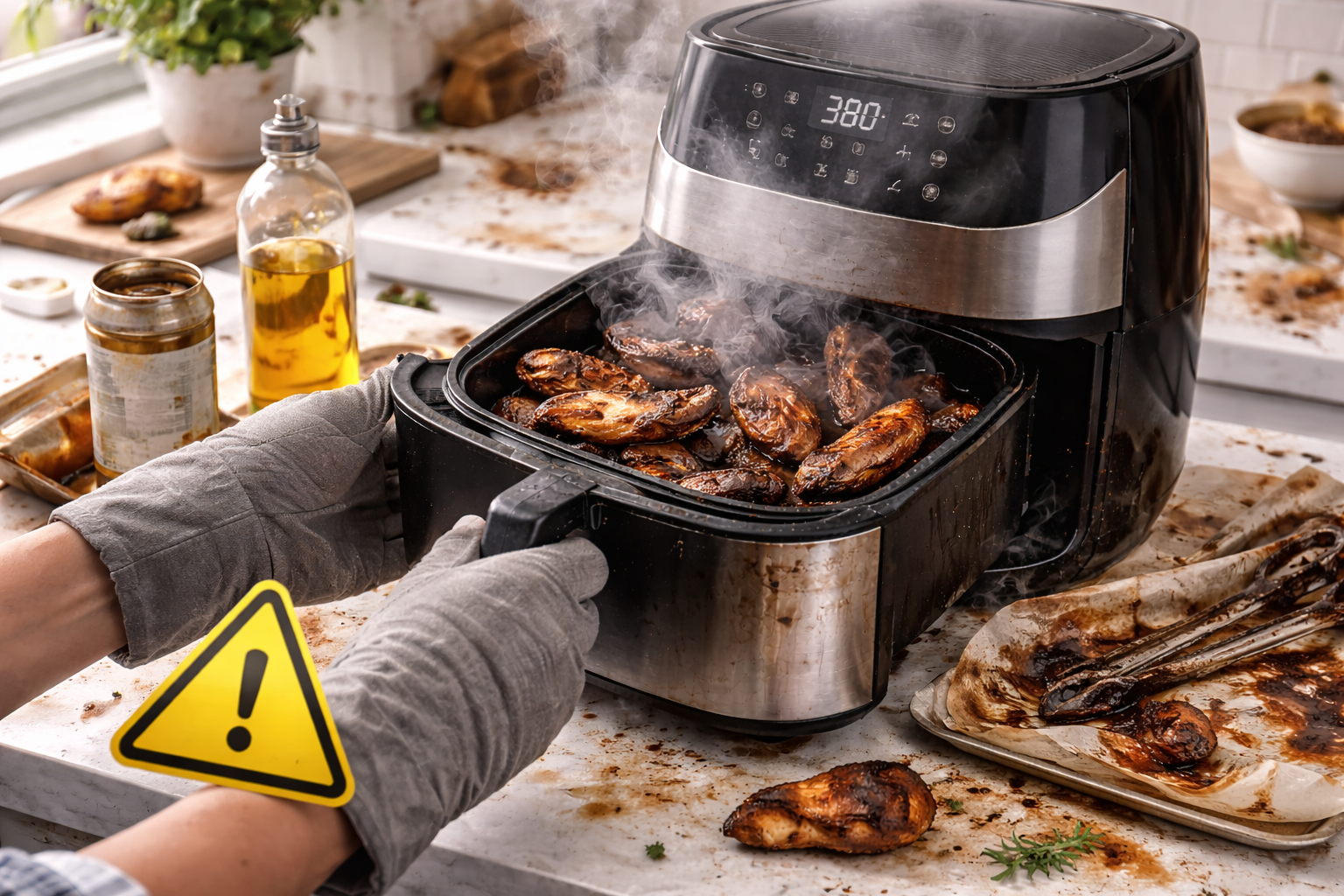
Air fryers arrive in our kitchens with the promise of ease. Faster dinners. Fewer dishes. Crisp food without the oil slick guilt. And for a while, they deliver. Then something goes wrong. Fries come out pale. Chicken turns dry. Smoke appears out of nowhere. You start to suspect the machine, when in fact the problem is usually human.
Most air fryer disasters come down to a handful of common mistakes. They are easy to make, rarely mentioned in manuals, and quietly responsible for a lot of disappointing dinners. The good news is that once you spot them, they are easy to fix.
There is no point invest in the best airfryer that money can buy if you end up either using it suboptimally, caring for it badly, or just not using it to its full potential. In this guide we take you through the most common airfryer pitfalls and how to avoid them.
Table of Contents
- 1. Treating the basket like a storage container
- 2. Skipping the shake, flip, or check
- 3. Using too much oil, or none at all
- 4. Ignoring preheating when it actually matters
- 5. Trusting presets without question
- 6. Forgetting that air fryers are small ovens, not fryers
- 7. Cooking everything at the highest temperature
- 8. Neglecting cleanup until it becomes a problem
- 9. Using the wrong accessories, or too many of them
- 10. Expecting one machine to suit every situation
- 11. Not adjusting recipes for size and model
- 12. Forgetting safety basics
- 13. The final mistake: blaming the machine
1. Treating the basket like a storage container
This is the big one. The mistake that causes at least half of all air fryer complaints. Overcrowding.
Air fryers do not cook by magic. They rely on hot air moving fast and freely around your food. When you pile everything into the basket like you are loading a suitcase five minutes before checkout, that airflow disappears. What you get instead is steam. Steam is great for dumplings. It is terrible for fries.
The fix is annoying but necessary. Cook in smaller batches. Spread food out so pieces are not stacked on top of each other. If it looks crowded, it probably is. Yes, this takes longer. Yes, it is worth it. Crispness demands space.
2. Skipping the shake, flip, or check
Many air fryer recipes insist you can just set it and forget it. This is optimistic at best. Most air fryers heat from the top, which means the top surface gets the brunt of the heat while the bottom waits its turn.
If you never shake the basket or flip the food, you are gambling. Sometimes you win. Often you do not.
Halfway through cooking, pause the machine. Shake fries. Turn chicken. Rearrange vegetables that have huddled together for warmth. It takes ten seconds and dramatically improves results. Think of it less as micromanaging and more as basic courtesy.
3. Using too much oil, or none at all
Air fryers do not need much oil, but they do need some. This is where people go wrong in both directions.
Drowning food in oil defeats the point and can cause smoking, splattering, and soggy results. Skipping oil entirely can leave food dry, pale, and stubbornly uncrispy.
The sweet spot is light coating. A teaspoon or two for a full basket. A spray works well, but make sure it is an oil that can handle high heat. Olive oil is fine at moderate temperatures. Avocado or canola is better when things get hot.
Oil is not the enemy. Excess is.
4. Ignoring preheating when it actually matters
Some air fryers preheat automatically. Some heat up so fast that preheating feels pointless. Others benefit from a few minutes of warming up, especially when crispness is the goal.
Putting food into a cold air fryer is like dropping it into a lukewarm pan. You lose momentum. Browning suffers. Cooking time stretches.
If you are cooking frozen foods, breaded items, or anything where texture matters, preheat for three to five minutes. It is not a ritual. It is a practical head start.
5. Trusting presets without question
Presets are helpful in theory. In reality, they are educated guesses designed to work reasonably well across many models and many foods. Your food is not average. Your air fryer is not the same as the one used in product testing.
If you treat presets as laws rather than suggestions, disappointment follows. Chips burn. Chicken dries out. Vegetables turn to charcoal confetti.
Use presets as a starting point. Adjust temperature and time based on what you see, smell, and learn. After a few weeks, most people abandon presets entirely. This is not failure. It is competence.
6. Forgetting that air fryers are small ovens, not fryers
The name causes confusion. Air fryers do not fry. They roast, bake, and convect aggressively.
This matters because not everything behaves the same way it does in oil. Wet batters drip. Delicate coatings blow off. Cheese melts and then escapes.
If a recipe relies on submersion, rethink it. Use dry coatings. Chill breaded foods before cooking so they set. Weigh down parchment paper with food so it does not fly into the heating element like a moth with poor judgment.
Once you accept what the machine actually does, rather than what it is called, results improve dramatically.
7. Cooking everything at the highest temperature
High heat is seductive. It promises speed and crunch. It also burns garlic, dries out lean meat, and turns herbs bitter in seconds.
Not everything belongs at 400 degrees. Vegetables often do better lower and slower. Chicken breasts benefit from moderation. Reheating leftovers absolutely does not require full blast.
Learn to use the temperature dial. Lower heat for longer can be more forgiving and often more delicious. Crispness is a combination of heat, airflow, and timing, not just aggression.
8. Neglecting cleanup until it becomes a problem
Air fryers are easy to clean, which makes them easy to ignore. A quick wipe becomes tomorrow’s problem. Tomorrow becomes next week. Suddenly the basket smells strange and smoke appears during cooking.
Old grease burns. Crumbs char. Residue affects flavor and performance.
Clean the basket and tray regularly. Not once a month. Not when something catches fire. Ideally after every few uses, especially if you cook meat. Warm water, mild soap, soft sponge. No steel wool. Your future self will thank you.
9. Using the wrong accessories, or too many of them
Accessories promise versatility. Racks, pans, liners, silicone inserts. Some are useful. Many interfere with airflow, which is the entire point of the machine.
If an accessory blocks air circulation, it will slow cooking and reduce crispness. If it barely fits, it will cause frustration and uneven results.
Start simple. Use the basket as intended. Add accessories only when you understand how your air fryer behaves. The more complicated the setup, the more variables you introduce.
10. Expecting one machine to suit every situation
Air fryers are excellent at many things. They are not universal solutions. Trying to cook for six people in a small basket will end badly. Expecting silent operation from a powerful fan is unrealistic. Demanding perfection from a budget model is optimistic.
Match expectations to reality. Use the air fryer for what it does well. Quick meals. Crispy textures. Smaller portions. Efficient cooking. Let the oven handle the rest.
11. Not adjusting recipes for size and model
Air fryer recipes are notoriously vague. Times vary wildly depending on basket size, wattage, and airflow design. Following instructions to the letter can lead to undercooked or overcooked food.
Check early. Adjust often. Take notes if you are the organized type. Experience matters more than precision here.
The best air fryer cooks are not rigid. They are observant.
12. Forgetting safety basics
Air fryers get hot. The exterior can heat up. Steam escapes when you open the basket. Grease can drip.
Do not crowd the appliance against walls. Do not place it under cabinets without clearance. Use oven mitts if necessary. Keep it clean to avoid smoke.
Most air fryer accidents are preventable with a bit of attention and common sense.
13. The final mistake: blaming the machine
When an air fryer disappoints, it is tempting to write it off as overrated. Sometimes the appliance really is mediocre. Often, though, it is doing exactly what it is designed to do, just not under ideal conditions.
Air fryers reward understanding. Once you learn their limits and strengths, they become reliable, almost comforting. Dinner happens faster. Cleanup stays manageable. Crisp food becomes routine rather than a gamble.
Avoid these common mistakes and the air fryer stops feeling like a fad. It becomes what it was meant to be all along. A useful tool that quietly earns its place on the counter.
Leave a Reply